


Technology
ABOUT
Nanoparticle Synthesis Using Laser Processes
We synthesize a wide range of nanoparticles using the intense, nonequilibrium reaction field generated near the focal point when a high-power pulsed laser is focused into a liquid. Depending on the material irradiated, these processes are broadly classified as bottom-up or top-down approaches. Both approaches support environmentally conscious operations through four features: no chemical reducing agents, processing at room temperature and atmospheric pressure, low power and energy consumption, and a compact system footprint.
Bottom-Up Approach
Our Proprietary Method — Pulsed-Laser-Induced Reduction (PLIR)
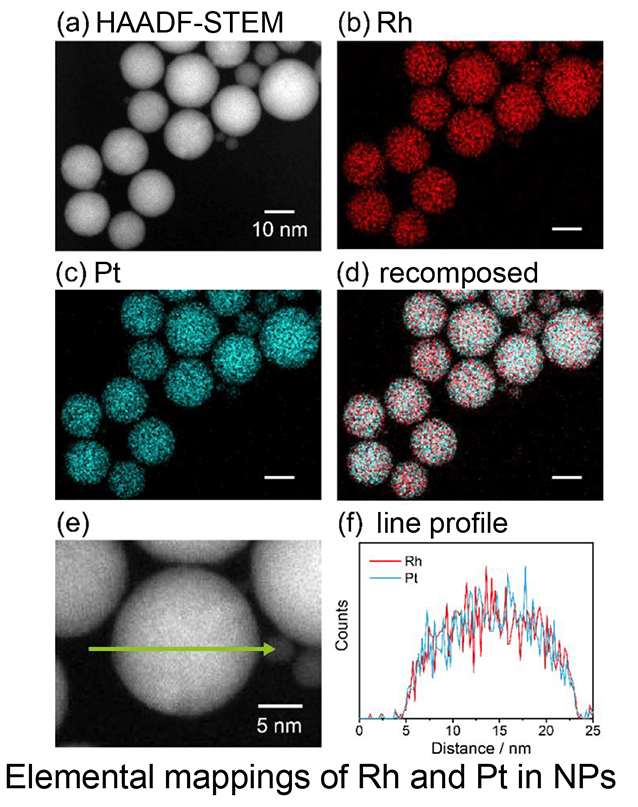
This is our proprietary nanoparticle synthesis method. A high-power pulsed laser is focused into a solution containing metal ions as precursors. Physicochemical reactions near the focal point generate nanoparticles. Unlike conventional chemical reduction methods, this process requires no reducing agents, eliminating the need for subsequent separation and purification associated with those agents. By using a solution containing multiple types of metal ions, we can control the composition of fully solid-solution alloys that are difficult to produce under conventional thermal equilibrium conditions. We can also modify nanoparticle surfaces, select dispersion solvents, and deposit nanoparticles onto supports.
Top-Down Approach
Pulsed-Laser Ablation in Liquids (PLAL)
Pulsed-laser ablation in liquids is a nanoparticle synthesis technique with a history of approximately 20 years and growing use worldwide. Laser irradiation is focused onto a solid target immersed in a liquid or into a colloidal dispersion of solid particles. The resulting ablation process produces particles smaller than the starting material. Femtosecond laser pulses, with their nonthermal processing characteristics, can produce fine particles while preserving the crystal structure of the original material. We have found that, when a colloidal dispersion contains multiple types of solid particles, alloying can occur during particle size reduction by ablation. A patent application is pending. This technique is expected to reduce particle size and improve the properties of materials already in practical use.
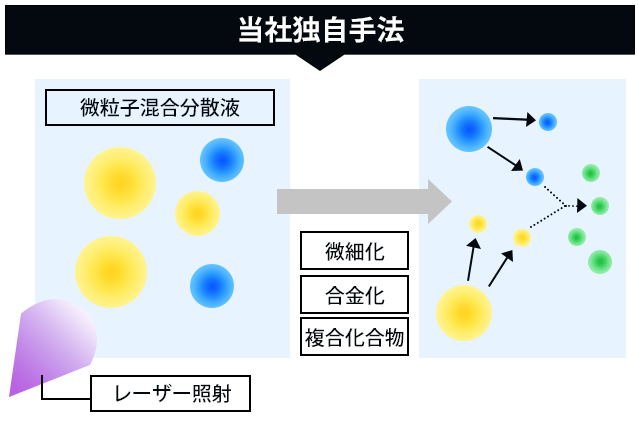
Dispersion of Mixed Fine Particles / Laser Irradiation
Particle Size Reduction / Alloying / Composite Compounds